User Guide
1. Term Retrieval (Search)
The search module is mainly used for TCM terminology retrieval.
Highlights:
- Bilingual Support: Search using either English (e.g., "Abdominal pain") or Chinese (e.g., "腹痛").
- Multi-Approach retrieval:
- Exact Match: Perfect matches for names(CN/EN).
- Semantic Similarity: Terms with similar meanings (Top 20).
- Substring Match: Terms containing your input text (Top 10).
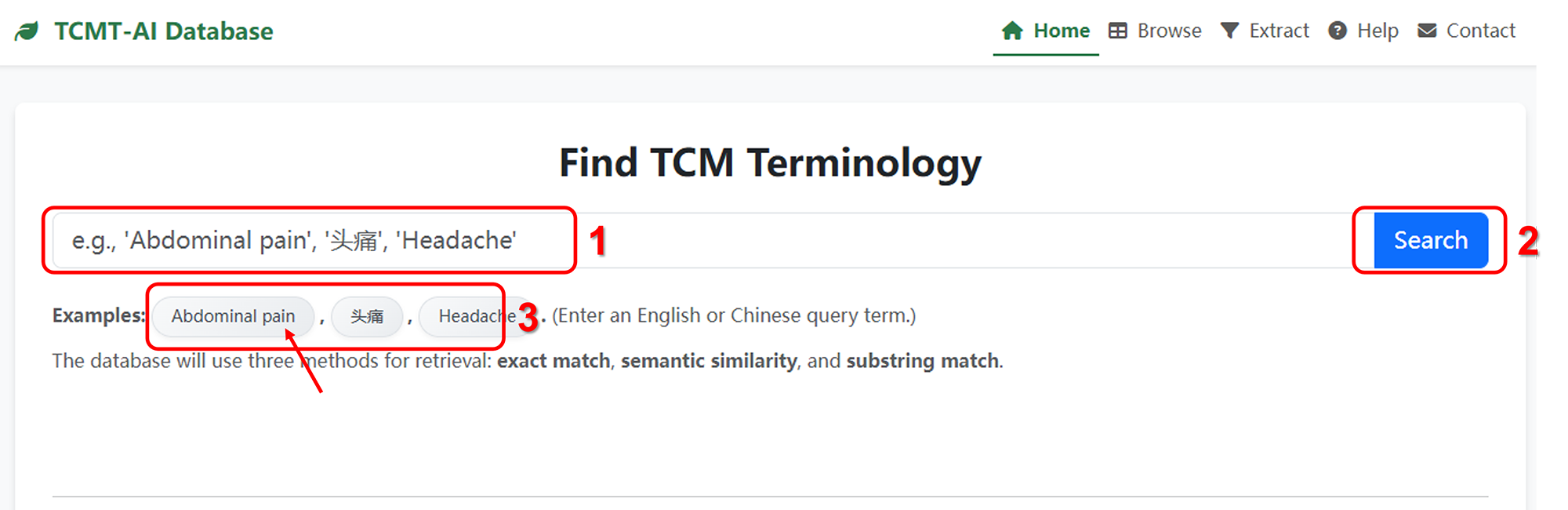
The database homepage (query page) is shown in the above figure.
1. Enter the term you want to query in the search box.
2. Click the search button to search.
3. Or simply click on the three example buttons under the search box.
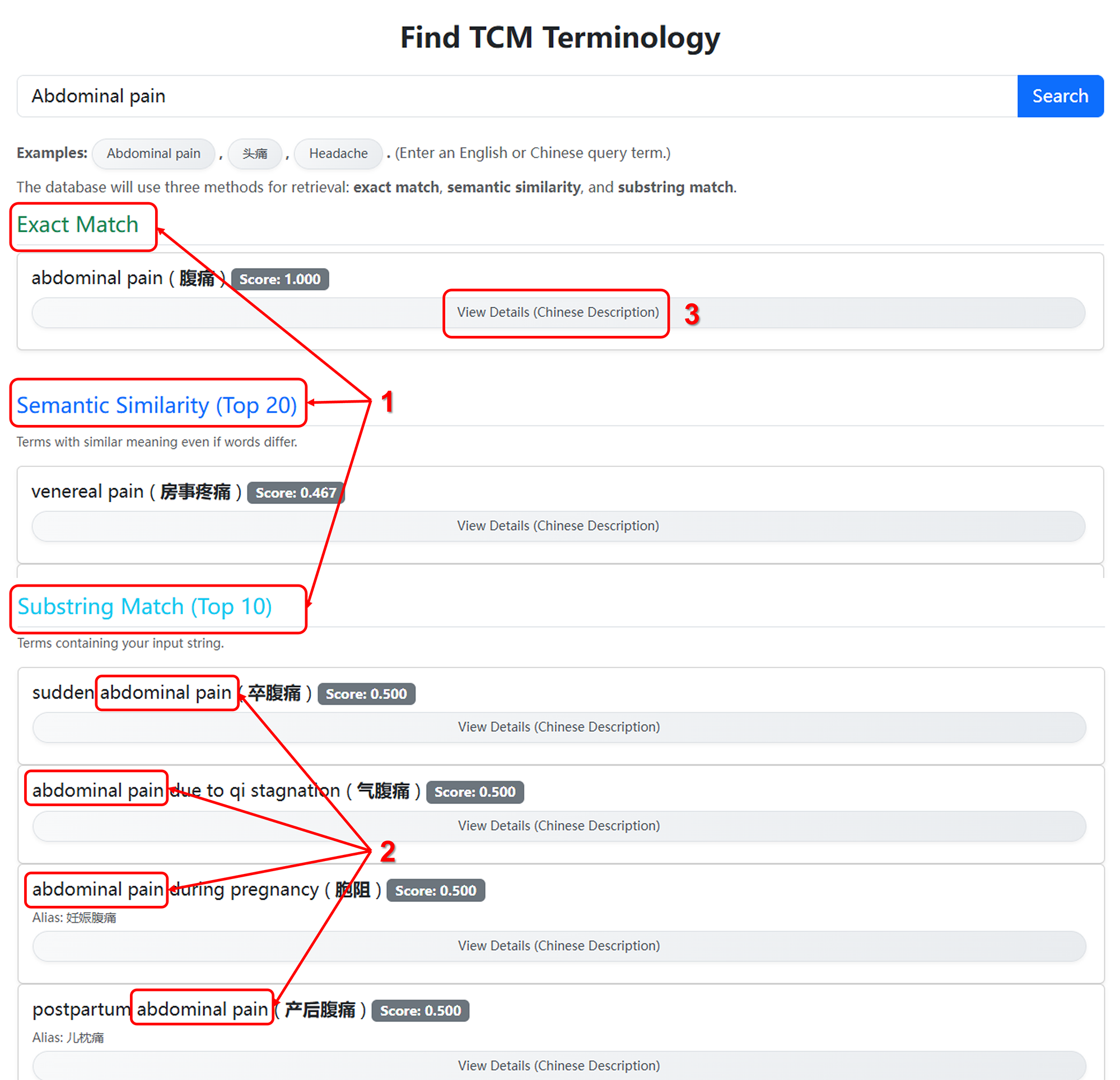
According to the query results, the returned content is not entirely the same.
Typical return results include:
1. Match mode indication (exact match, semantic similarity, and substring match.)
2. Substring Matching Diagram
3. Query detailed information button.
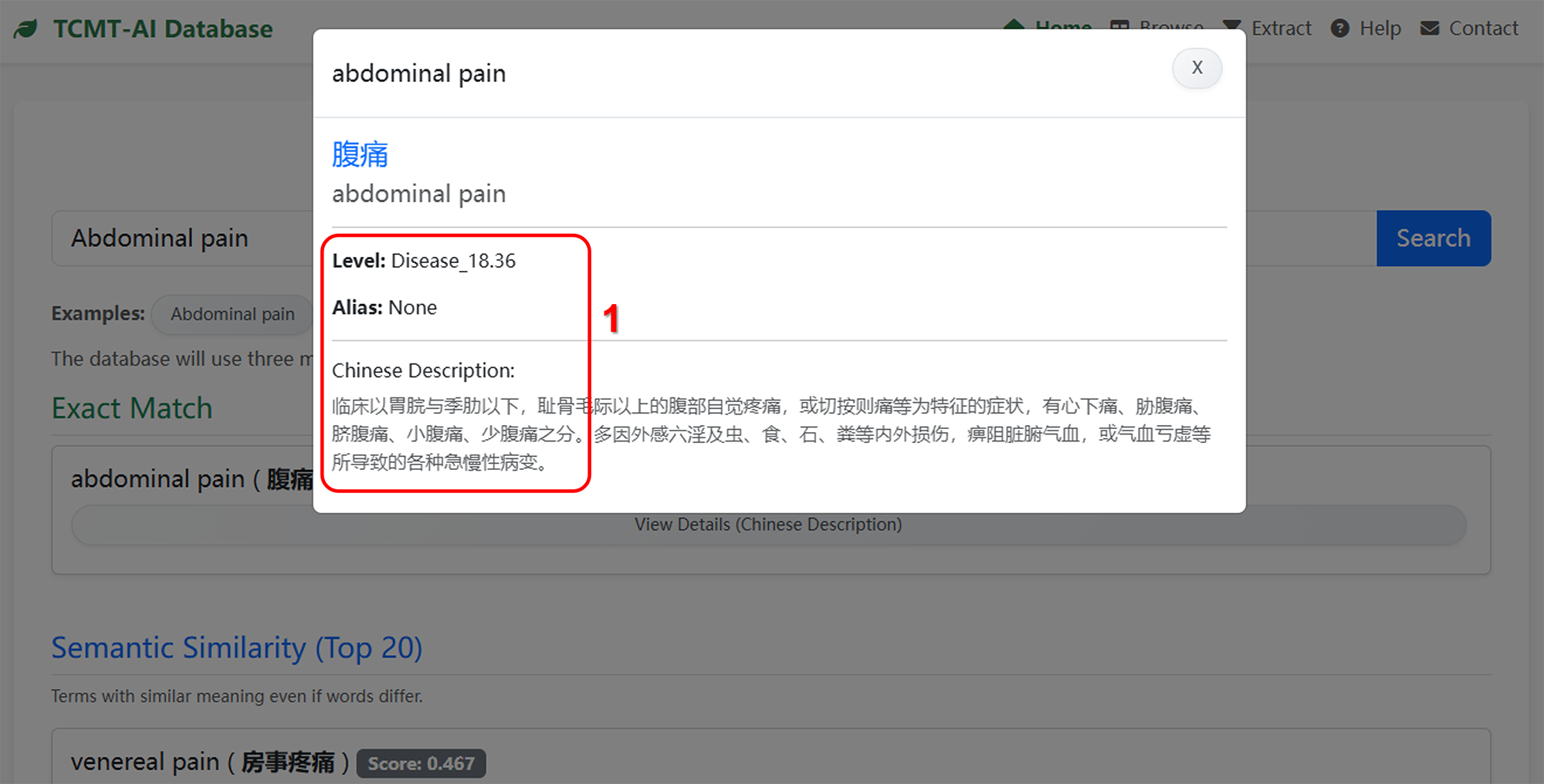
The database returns detailed information in the form of pop ups.
The detailed page content mainly includes hierarchy, aliases, and Chinese descriptions.
2. TCM Database Browser (Browse)
The Browse module is mainly used to browse TCM terminology by category.
Categorized Views:
-
Diseases: Broad disease categories.
For instance:- bone impediment (骨痹)
- common cold disease (感冒)
-
Syndromes: a comprehensive clinical profile derived from TCM's holistic observation and analysis of a patient’s symptoms, signs, and constitution.
For instance:- syndrome/pattern of liver depression and spleen deficiency (肝郁脾虚证)
- syndrome/pattern of cold congealing and qi stagnation (寒凝气滞证)
-
Therapies: Treatment principles and methods.
For instance:- clearing heat and resolving turbid dampness (清化湿浊)
- small needle knife therapy (小针刀疗法)
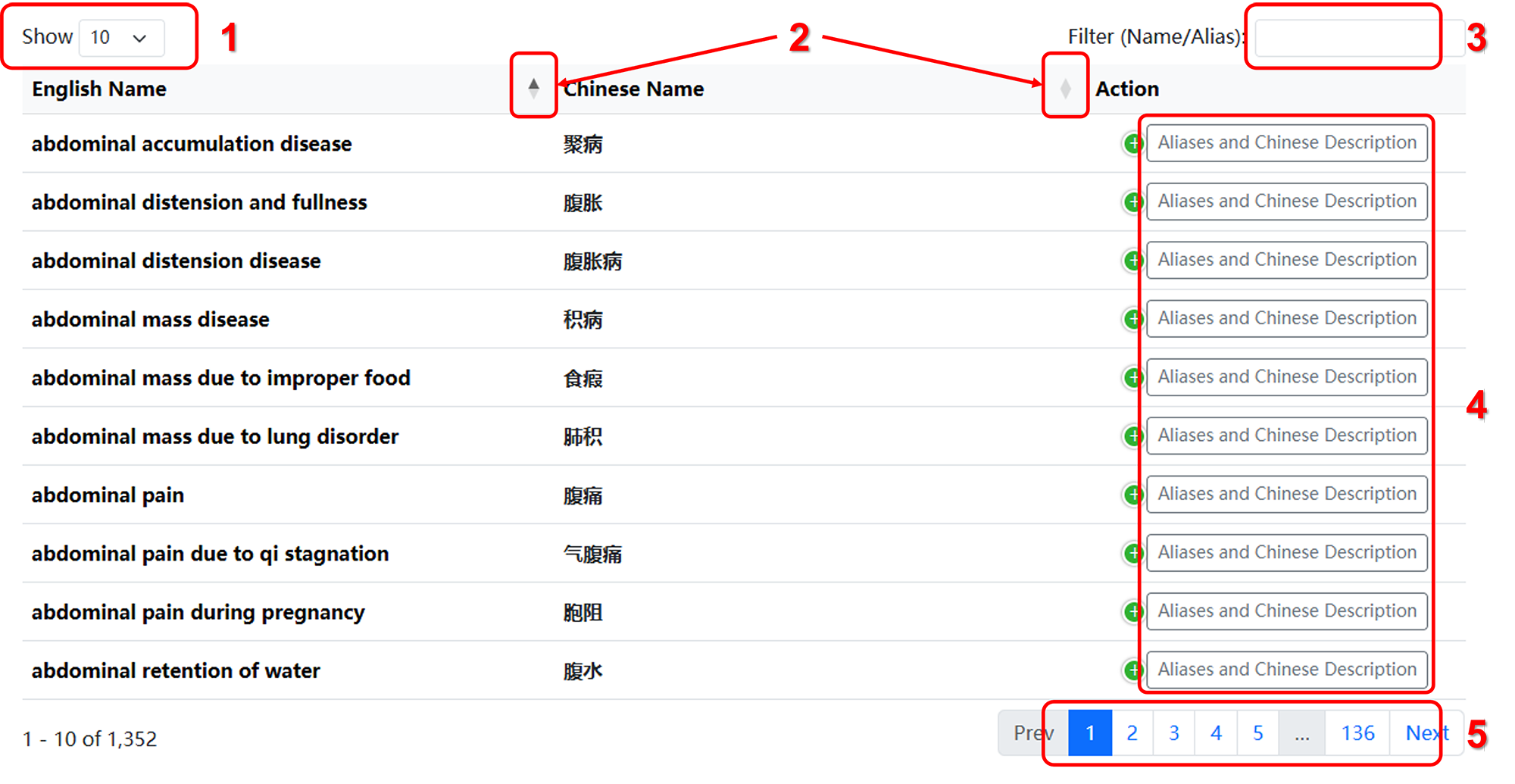
The main functions of browsing the page are shown in the above figure.
1. Adjust the number of displayed terms through dropdown options (supports displaying 10-100 rows in a single table).
2. Adjust the sorting order through the up and down buttons (supports sorting by Chinese or English name).
3. Quickly filter by entering terminology.
4. Click the button to display more content (including aliases and Chinese descriptions).
5. Use page number buttons to turn pages.
3. Clinical Inference (Extract)
The extraction module is used to handle chaotic and colloquial patient complaints.
The extraction module breaks down lengthy narratives into short sentences and analyzes each sentence separately based on a self built chief complaint feature dictionary, thereby ignoring details unrelated to the disease and focusing on typical medical symptoms.
"My husband went out walking and didn't tell me, I'm so angry, he didn't answer the phone... but now I feel my heart racing and panicked, doctor, my life is so bitter."
Patient presents with clinical presentation suggests category of heart system syndromes/patterns (心系证类), syndrome/pattern of heart heat and blood stasis (心热血瘀证), potential diagnosis includes heartache due to chest impediment (胸痹心痛), sudden heart pain (卒心痛).
(Note: Unrelated details will be filtered out.)
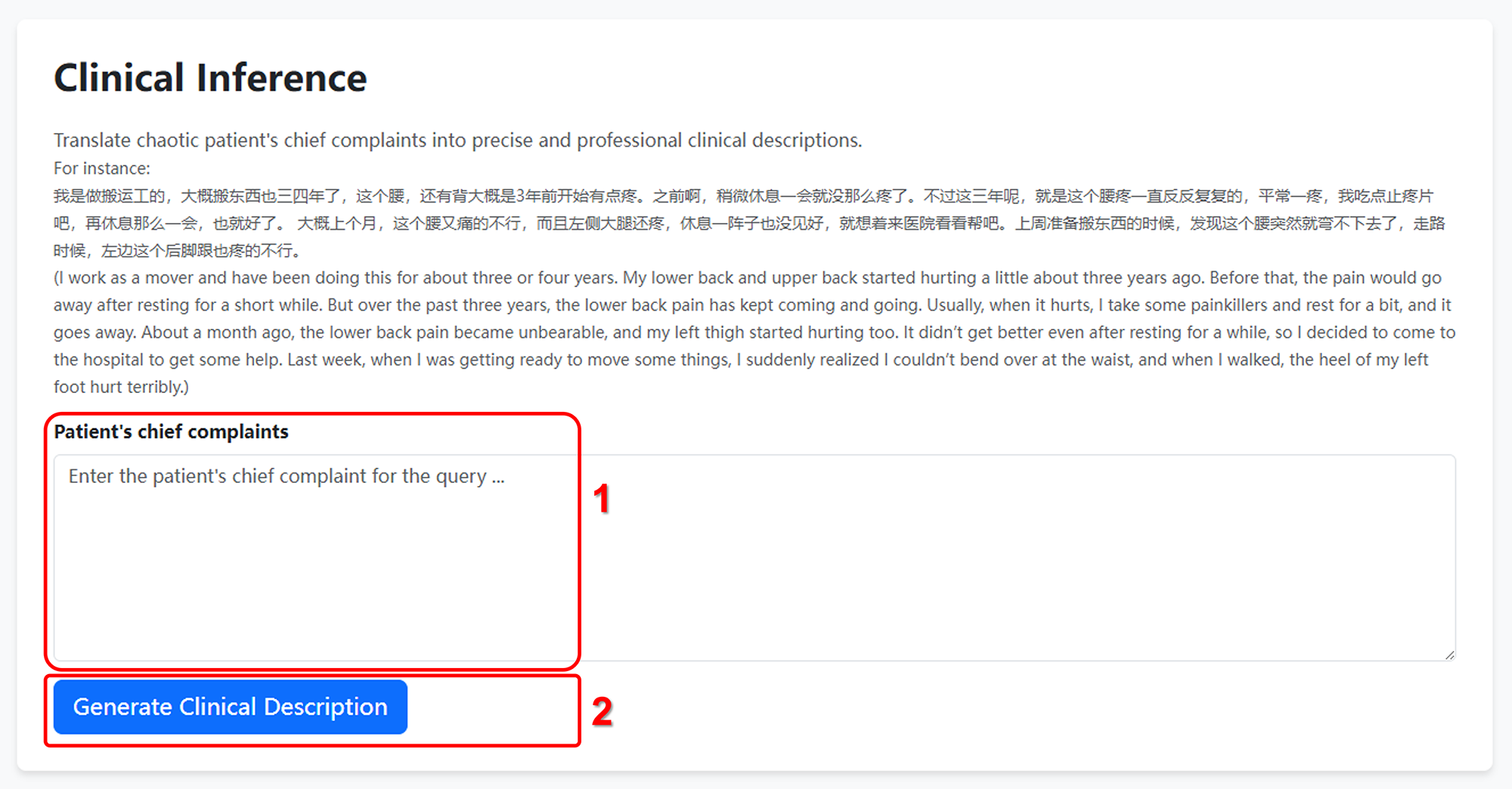
The Clinical Inference page (Extract page) is shown in the above figure.
1.Clinical doctors can input professional complaints in the text box,
while general searchers can input oral or written disease descriptions according to their own needs.
2.Click the "Generate" button to perform a database query.
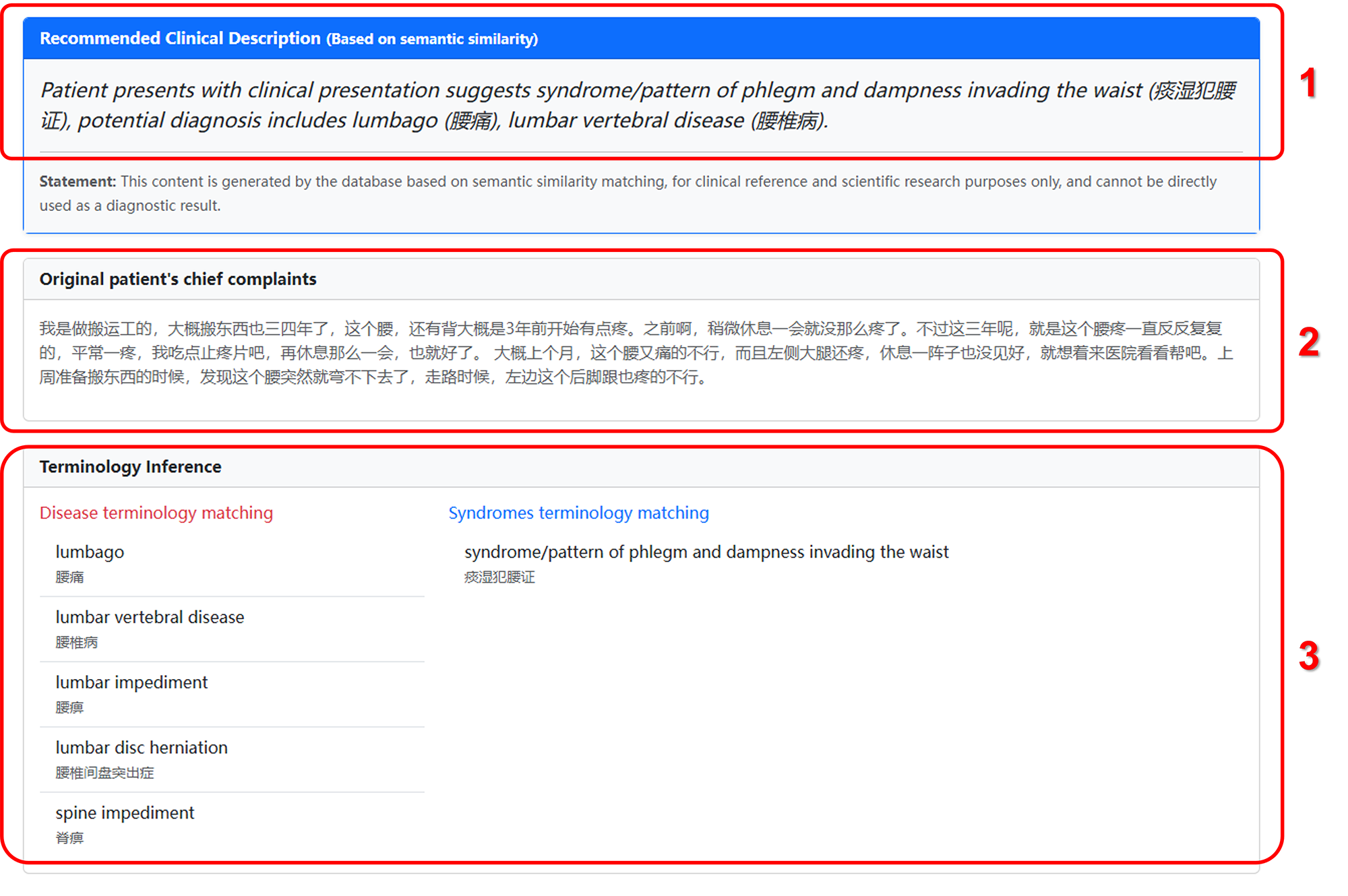
The typical return result of the Clinical Inference page is shown above
1. The database constructs potential clinical descriptions using the top 2 symptoms and diseases based on matching scores.
2. The Original Complaint Restatement displays the user's original input content.
3. In the Terminology Inference section, the database will return up to 5 candidate diseases and 5 similar traditional Chinese medicine symptoms.
4. System Information
Data Source: National Administration of Traditional Chinese Medicne
AI Model (sentence-transformers): bge-large-zh-v1.5 and all-MiniLM-L6-v2.